Jan 15

Pioneers revisited

In my second post to this blog (written 3 October 2001), I tried to identify some of the astronauts who appear during the title sequence of Star Trek: Enterprise. Tonight I discovered that the Startrek.com website has a page that explains most of the images in the sequence. Does that mean I can now find out whether my guesses were correct? Well, not entirely. The Opening Credit Sequence Timeline doesn’t cover every single image in the credits, and some of the ones I tried to identify are among the missing ones. But let’s take another look at my list anyway. My guesses were as follows:

  • A test pilot in front of his plane — maybe Gus Grissom, maybe Chuck Yeager. The timeline doesn’t mention this image, so the pilot’s identity remains a mystery for now.
  • A close-up of Alan Shepard, suiting up for Apollo 14. Correct!
  • An Apollo crew during launch, probably on Apollo 13. Wrong! This shot does show three astronauts experiencing a launch, but they’re in the mid-deck of a space shuttle.
  • An Apollo crew walking down a corridor, possibly from Apollo 11. It’s an Apollo crew, but the timeline doesn’t say which one.

One right answer, one wrong answer, and two inconclusive ones. Rather unimpressive for a self-proclaimed Apollo buff. I guess I should hang onto my day job.

Jan 14

More names

The silly names stopped for a while, but I got two more this morning: Untroubled L. Desired and Residential K. Shuteye. A few days ago, I also received one that wasn’t generated by the same program, because it had no middle initial at all. But it was still funny: Urban Gosling.
UPDATE: The latest is Goiania H. Categorize. I didn’t recognize Goiania, so I looked it up. “A city of south-central Brazil southwest of Brasília. It is a shipping and processing center in an agricultural and cattle-raising region. Population: 920,840.” Well, that’s something I didn’t know when I woke up this morning. So now my spam is not only entertaining, but educational as well.

Jan 07

Fun with spam

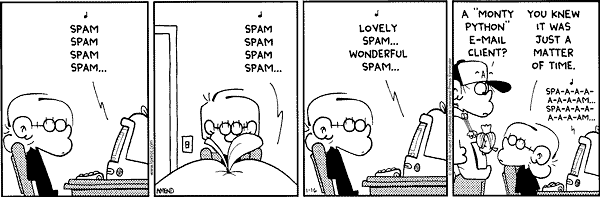
In the last few days, I’ve started receiving some spam e-mails that I actually don’t mind very much, because they make me laugh. Most spam messages have ordinary-sounding names in the “From:” field, probably taken from some big-city phone book. But this latest crop of spam is using a different method. The program that sends the messages is generating very silly sender names by randomly picking two words from a dictionary and inserting a middle initial between them. As a result, yesterday I received spam e-mails from Modules H. Zip, Avenue H. Scrimshaws, and Lithographer H. Draftsman.
Noticing that all three names have the same middle initial, I concluded that the name generator always uses H. But I was wrong. Today I got another of these messages, and it was from Downplay G. Brokerage. Maybe it uses a different middle initial every day? I can’t be sure without more samples. Hopefully I’ll receive some more tomorrow. Good grief! I never thought the day would come when I would actually look forward to receiving more spam.
UPDATE: Another one arrived while I was writing this post! It’s from Subcontinent V. Marquises. I’m glad I wasn’t trying to drink anything when I read that name — I would be wiping the beverage off my screen right now.

Jan 07

Don’t get cocky

My alma mater, the University of South Carolina, scored a victory at bowl game on New Year’s Day — specifically, the Capital One Bowl in Orlando. It’s true that the Gamecocks did not, technically, play in the Capital One Bowl. But team mascot Cocky won the College Sports Mascot competition. According to this newspaper article, Cocky defeated 11 other finalists, including “a bear, an alligator, two fierce felines and two large dogs.”
When I pointed this out to Bob (who also went to USC), he commented that a popular vote was a lame way to resolve such a competition. “It should have been a fight to the death,” he said. “I’d like to see how a chicken would fare against bears, alligators, and dogs.”
“Well, remember that this is a cockfighting chicken with razor-sharp blades strapped to his feet,” I said.
“Yeah, but it’s still a chicken.” Bob replied. “Unless it’s wearing armor and is packing a gun, my money is still on the carnivores.” I can’t argue with that.

Jan 03

Performing Cinderella, part 1: Before the show

Now that I’ve given you the scene breakdown for Cinderella, I want to describe what I actually do in the show. Although the play is now over, I’ll write this in the present tense for simplicity. I’ll describe a 7:30 p.m. weekday performance, but this timeline is also valid for a 1:00 or 5:00 weekend show. I plan to stop and explain a number of things, and I’ll put those digressions in italics so you can skip them if you like.
Morning. After showering and before shaving, I apply a moisturizer to my face.
Like most guys, I normally don’t give much thought to my skin unless it malfunctions or something pokes a hole in it. But for actors, facial skin is a tool — the canvas on which you use makeup to paint your character. So keeping that skin in good condition becomes imperative. Applying and removing stage makeup several times a day dries out my face and leads to soreness (especially in the area around my eyes) if I don’t take precautions. At the makeup workshop on December 5, one of my fellow actors recommended a light, nongreasy moisturizer called Cetaphil, and that’s what I use.
5:00. Before leaving work, I eat supper at my desk.
During the show’s run, I prefer to drive directly from IBM to the theatre, so I bring my supper to work and eat in my office before leaving work. I either go out for lunch or bring that meal to work as well. This is one of the reasons I recently bought a bigger backpack.
5:45. I leave work and drive to the BTI Center. On the way over, I use my electric razor to touch up my shave. When you’re applying stage makeup, you don’t want to have any stubble.
6:15. I arrive at the theatre, sign in on the call board, and walk down the corridor to the ensemble men’s dressing room. Removing everything from my pockets (wallet, keys, coin purse, Swiss Army knife, Palm), I store it all in a pocket of my backpack. I turn off my mobile phone and put it in too, along with my wristwatch. I stash the backpack against the wall underneath my costumes (which are hanging on a rod that runs along one wall of the dressing room). I visit the restroom. (I’m a bit paranoid about making sure my bladder is empty before I go on stage.)
6:30. The other cast members have been arriving, and now someone knocks on our door and says it’s time for vocal warmups. We climb the stairs to the stage, where the entire cast is assembling, most still clad in street clothes, some with their makeup partly done already. Music director Jane is sitting at her keyboard in the orchestra pit, and she leads us through a few minutes of voice exercises. When she’s done, ensemble member Elanah takes over and leads stretching exercises.
If the stage manager or anyone else has announcements for the cast, this is when they speak up. For example, a cast member may say, “You’re all invited to a cast party at my place after Thursday’s performance. I’ll post handouts with directions on the call board.” On December 20th, Jane surprised me by announcing that it was my birthday and playing “Happy Birthday” on her keyboard while the whole cast sang to me. Until that moment, I had completely forgotten that it was my birthday.
6:40. Back in the dressing room, I remove my glasses and put in contact lenses. I use a facial-cleansing wipe to clean my skin and then apply moisturizer. I take off my street shoes and put them with my backpack, then remove my street clothes (leaving only my underwear) and put on the RLT-provided white undershirt, the bottom half of my Prologue costume (baggy white clown pants with elastic suspenders), and white crew socks. I fold my street clothes and place them on the shelf above the rod where my costumes hang.
The contacts are daily-wear lenses that I obtained for the play, because I can’t wear my glasses on stage. Lenses that completely correct my vision would have to be special-ordered and would be too expensive, so these lenses correct only my nearsightedness and not my astigmatism. I couldn’t use them for driving, but they’re perfectly fine for use on stage, where I just have to see well enough to avoid walking into the scenery.
6:50. I visit the restroom again. Time to get started on my makeup. I open my makeup kit, pull out my container of Clown White, and start applying it to my face. Using the tip of my index finger, I put dots of makeup on my forehead, cheeks, chin, and nose until I look like I’ve contracted some horrible disease, then spread it evenly over my entire face from hairline to jaw line.
My makeup kit is a small tackle box that I bought at Wal-Mart during last year’s Cinderella. Many actors use triangular cosmetic sponges to apply and blend makeup, but I prefer using my fingertips because it gives me better control of where the makeup goes. This may be because all of the foundations I’ve used so far are creams — if I were using a powder base, the sponges might be more useful. On the other hand, I might just use a cosmetic puff instead.
7:00. The speakers in the dressing-room ceiling come to life as the stage manager or one of the ASMs (assistant stage managers) announces that the house is open (audience members are now being seated) and then says “25 minutes until places.” I apply lipstick, then start using an eyeliner pencil and mascara to define my eyes.
Stage makeup sometimes is used to change your appearance for a role — adding lines to make you look older, for example — but its basic function is to make your features visible to the audience. Without makeup, the combination of distance and bright lighting will make your face look like a featureless oval. So you have to use foundation and lipstick to restore color, eye makeup to emphasize the borders of your eyes, and highlight and shadow makeup to exaggerate raised areas (such as cheekbones or the bridge of your nose) and hollows (under your cheekbones and eyebrow ridges, for example). Highlight and shadow don’t apply to clown makeup, but I define my eyes by using mascara to darken my upper eyelashes and by drawing a line along the edge of each lower eyelid with a black eyebrow pencil. And, of course, lipstick makes my mouth visible.
7:10. “Fifteen minutes to places” comes over the speakers. I use the eyebrow pencil to draw high, arched eyebrows above my real eyebrows, which are more or less obscured by the Clown White. The Pierrot style of clown makeup calls for stylized teardrops, so I draw a short black line downward from the center of each lower eyelid. Using a small brush, I draw circles on each cheek with rouge. After applying a layer of translucent powder over my entire face, I open a pair of small stick-on earrings (hearts or diamonds) and glue one to the bottom of each teardrop line.
The purpose of the translucent powder is to “set” the makeup, giving it a dry surface that hopefully won’t rub off on things. Our costumer originally gave me small rhinestones to use as teardrops, glued to my face with spirit gum. But the Cinderella concession stand in the lobby sells stick-on earrings (along with tiaras, magic wands, and so forth), and these turn out to be perfect for use as teardrops. Since they have their own adhesive, no spirit gum is required — I can just peel them off the backing paper and press them on.
7:20. “Five minutes to places.” The makeup’s done. I visit the restroom one more time (I told you I’m paranoid about this). Time to finish getting dressed. I put on black jazz shoes (no big floppy clown shoes for me, I have to dance in this outfit!), then remove the top half of my costume (a big, baggy white shirt with long sleeves) from its hanger. This shirt has a drawstring collar that ties in the back, so I put it on over my head backwards, pull the drawstring tight in the front and tie it, then turn it around and put my arms through the sleeves. There’s also a separate black ruff collar, which ties around my neck with a ribbon. Finally, I put on the Pierrot headgear: a close-fitting black hood (instead of a wig) and a black top hat. I check my makeup in the mirror to make sure I haven’t smudged it.
7:25. “Actors to places, please.” Stepping out into the corridor, I meet the other three members of the quartet, and we climb the stairs to the stage left wings. The stage left ASM and several other crew members are there, and cast members greet us quietly or say “break a leg” as they pass through to take up their places behind the red drape. The Fairy Godmother (FGM) and Curtis, who plays one of her helpers, arrive. (The other helper is already in the stage right wings.) We can hear the audience murmuring in the house.
The red drape is a curtain that conceals the townspeople while we (the quartet) sing our song in front of it. We are a troupe of traveling entertainers who are arriving in the town as the play begins. As we enter, we ad-lib chatter about the town and our journey, stop and ad-lib more comments about the audience and the fancy clock on the archway over the stage, then begin our song. As we finish, the drape rises to reveal the townspeople, and the prologue really gets under way. The fairy helpers are on stage during the prologue, but they stand frozen on pedestals on both sides of the stage, pretending to be statues. A large conical Christmas tree stands in the center of the stage, acting as a centerpiece for the scene. It’s also the where the FGM is hidden during the prologue — it’s hollow and has a door-shaped opening in the side that faces away from the audience.
7:30. The townspeople are in place, and one of the crew members reports to the ASM that the FGM is now in the tree. A prerecorded announcement in the FGM’s voice plays over the house speakers, pointing out the locations of the fire exits and asking audience members to turn off their phones and pagers. The five of us (quartet and Curtis) wait as the final moments tick away, mentally reviewing our song lyrics and dance steps. We hear applause from the audience as a spotlight picks out Jane in the orchestra pit. She bows, the spotlight flicks off, and the house lights fade. Curtis moves past us onto the dark stage and steps up onto his pedestal. The quartet is already lined up in the order of our entrances — Anne first, then me, followed by Meredith and John. As we tiptoe to the edge of the stage, Jane begins playing on her keyboard the sound of the town clock striking the hour. That’s our cue. The lights come up on stage as we start our ad-lib chatter, walk out on stage, react to the clock and the audience, and begin to sing.
(Continued in Part 2.)
Dec 31

License plates

Since the middle of summer, I’ve been playing the License Plate Game: try to spot a license plate from every state in the U.S. by the end of the year. Greg and Virgil have been doing this for several years, using their Palms to keep track of their progress, and I decided to give it a try. I think I’ve done pretty well, considering that I started playing after half the year was already gone. But on the last day of the year, I’m still two states short — I haven’t seen Idaho or South Dakota. Unless a double miracle occurs in the next six hours or so, I’m not going to complete my 2003 checklist.
So I’ll start over with a new checklist tomorrow morning. I just wish I hadn’t seen an Alaska plate yesterday on my way to work. Argh! I’ll need that one tomorrow, but right now it’s useless. (I actually saw plates for Idaho and South Dakota a few days ago, but they were expired plates for sale in a truck stop. The rules of the game state that the plate has to be attached to a vehicle. So those were equally useless.)

Dec 31

What have I done?

I only meant to sabotage Jen’s NaNoWriMo project, but apparently I underestimated my own powers. After posting nothing for almost a month, she has finally reappeared with the revelation that she has lost the ability to blog. This is terrible — and it’s all my fault! I am now working to repair the damage, but I may need some help with this. Everyone, please focus all the positive psychic energy you can spare in Jen’s direction so that she’ll recover quickly from this case of Blogger’s Block and start posting again. Do it for Jen — and for me, because I don’t want to go down in history as the evil mastermind who killed Jen’s blog!

Dec 30

Movies about the sea

Bit by bit, I’m emerging from my Cinderella spider hole. Over the weekend, I started to chip away at my movie backlog by watching a couple of DVDs (I’m so far behind that some of the films in my backlog are already available in disc form). Ruth has been pestering me to watch Pirates of the Caribbean ever since that DVD came out, and she finally screened it for me on Christmas Day. I like swashbuckling adventure films, and this one definitely fits that description. I think the sword duel in the blacksmith’s shop may well end up on everyone’s lists of classic action scenes, along with the shootout at Marion’s tavern in Raiders of the Lost Ark and the gun battle on the riverboat in The Mummy.
The next day, my nephew Jason dumped a half dozen of his newest DVDs on the table in front of us and said we were welcome to watch anything we wanted. I immediately latched onto Finding Nemo, which I missed when it was on the big screen. There was no question that I would enjoy it; Pixar never disappoints. As Bob has pointed out, what most people notice about Pixar is the superb computer-generated graphics, but that’s not what makes all Pixar films huge successes. People of all ages love Pixar movies because of the quality of the writing. Nemo is no exception. I find the movie’s theme — the triumph of hope over fear — very moving. I would try to explain why, but Iain Murray has beaten me to it; his article on the subject was published today at National Review Online.
I still have a lot of movies to watch before I’m caught up. Some of them aren’t out on DVD yet, so I’ll have to go to one of those buildings with lots of seats and a great big screen on one wall. It’s been so long since I’ve been to one that I forget what they’re called. It’s a word something like “theatre,” but I know that’s not right; “theatre” is the place with dressing rooms and a stage where I spent the last two months of my life. Oh, well, it’ll come to me eventually.

Dec 27

Scene breakdown

Cinderella may be over, but I’m not done writing about it yet. There were several blog entries that I wanted to write while the show was in progress, but I ran out of time. So I’m going to do it now while the experience is still fresh in my mind.
A couple of those entries will have to refer to specific scenes in the play, and those references won’t mean much to you unless you know what those scenes are and the order in which they occur. There are only fourteen of them, so I’ll just list them here:

  1. Prologue: A quartet of commedia dell’Arte players comes on stage and sings a song to the audience. The curtain behind them then rises, revealing the people of the town going about various activities as they prepare to celebrate Christmas.
  2. “Hi Diddle Dee”: The Fairy Godmother (FGM) and her two helpers sing a song that introduces them. Then they review their list of needy cases and identify Cinderella as a candidate for their next magical intervention.
  3. “What’s to Become of Me”: While FGM and her helpers watch invisibly, Cinderella sings a solo about her sad lot in life.
  4. “Get to Work”: Stepmama and the Ugly Stepsisters enter and order Cinderella around, then sing a song in which they give her lots of work to do. FGM decides she definitely has to help Cinderella. Remembering that today is Prince Charming’s 21st birthday and he has to choose a bride by midnight, she tells her helpers to disguise themselves as royal guards and observe what’s happening at the palace while she looks up some magic spells.
  5. “King Darling the Third”: In the throne room, the nearsighted king sings a song (along with his two pages and the two “guards”) that introduces him. Then Prince Charming the First enters and the king reminds him of the impending deadline. The king hits on the idea of holding a ball that evening and inviting every unmarried woman in the realm so that the Prince can choose one. He orders the “guards” to deliver the invitations.
  6. “If I Gave You a Silken Ribbon”: The Prince sings a solo about his difficult lot in life and his failure to find a bride. FGM arrives, receives an update from the helpers, and tells them to go ahead and deliver the invitations; she’s going to make sure Cinderella attends the ball.
  7. “Knock! Knock! Knock!”: The “guards” deliver a singing invitation to the Stepmama, the Stepsisters, and Cinderella. Stepmama tells Cinderella she can’t go to the ball.
  8. “At the Ball”: Stepmama and the Stepsisters sing about going to the ball, then depart, leaving Cinderella behind.
  9. “By My Fire”: Cinderella sings about her sad lot in life some more. FGM and her helpers appear and tell Cinderella that she’s going to the ball after all. They transform a pumpkin into a golden coach, six mice into horses, and Cinderella’s plain dress into a beautiful gown. FGM instructs her helpers to accompany Cinderella to the ball; she will also go, but will remain invisible.
  10. The Ball: The ball is already in progress when Cinderella arrives, astonishing everyone with her golden coach and breathtaking gown. By the end of the ball, the Prince is thoroughly smitten and asks Cinderella to marry him. She accepts, the clock strikes midnight, and she flees, leaving a glass slipper behind.
  11. Prince in the House: The heartbroken prince decides to search the entire kingdom for the woman whose foot fits the slipper. Accompanied by the king and the two “guards”, he goes out into the house and tries the slipper on various members of the audience.
  12. Slipper Scene: After visiting every other house in the kingdom, the party reaches Stepmama’s house. After trying the slipper on Stepmama and both Stepsisters, the Prince identifies Cinderella as the mystery princess from the ball and once again asks her to marry him.
  13. “Hi Diddle Dee” Reprise: Both families head back to the palace for the wedding, while FGM and her two helpers sing a reprise of “Hi Diddle Dee.”
  14. Finale/Bows: The ensemble and principals take their bows, sing “We Wish You a Merry Christmas” to the audience, and then exit to the lobby to greet audience members and sign autographs.

The ensemble and the Mouse Ponies are involved in just four of these scenes: the Prologue, “By My Fire,” the Ball, and Finale/Bows. (The ensemble is heard but not seen in “By My Fire”; they sing offstage during the last verse of the song.)

Dec 23

Happily ever after

It’s over! Cinderella XX has ended its run. And a good thing, too; I don’t think I would have lasted much longer.
The Friday night performance went okay for me, although I was worried about Jo Brown. She was feeling increasingly ill and got through that show mostly on sheer willpower. Since we didn’t have to arrive at the theatre until noon on Saturday, I had planned to sleep comparatively late that morning, but I woke up at 5:00 a.m. with a sore throat. I was able to clear up the soreness by drinking a couple of glasses of water and went back to bed, but when my alarm went off at 9:00, I was still somewhat hoarse.
When I got to the theatre at noon, there was a mixture of good and bad news. Sandi was back and ready to reclaim the role of Fairy Godmother, but Jo was now too sick to perform. She had gone home to rest, and Becky Johnston would be staying on as Stepmama to the end of the run. The two Saturday shows went surprisingly well, considering that Sandi was stepping back into her role after over a week away from it. But she’s a trouper, and performed as if she had never been away. I, on the other hand, was struggling to keep my voice from cracking. The only place where this really mattered was the very beginning of the play, when the quartet enters and sings to the audience. That song is four-part harmony, with me as the only bass — so if my voice were to give out, there would be no hiding that fact from the audience. I got through it, but my singing sounded ragged in my own ears. (The other members of the quartet swore they couldn’t tell, but perhaps they were just being kind.)
The rest of the show wasn’t as risky, because I only had to sing when the entire ensemble was singing. I cheated a bit and just lip-synched part of the “Sneeze Polka,” one of the song-and-dance numbers in the Ball scene. By the end of the show I had figured out that I could keep my voice more or less under control as long as I was singing fairly loudly. Between that trick and lip-synching, I was able to get through the evening performance. On Sunday I had the same experience; I woke up with a sore throat, banished it with lots of water, and managed to produce enough baritone to sing two more shows.
The final performance began at 5:00 and ended about 6:30, and we had to be out of the Fletcher Opera Theatre by 11:00 p.m. And when I say “we,” I mean the cast, crew, scenery, props, costumes, and all personal items. Everything. So the strike had to proceed rapidly. Normally, I tend to think of a strike as something that begins immediately after the final curtain, but that’s only true of striking the sets. For everything else, the strike begins while the final performance is still under way. For example, we started striking costumes immediately after the first scene. Costume strike instructions were already posted on all the dressing room doors, so we knew what to do. As soon as we were done with a costume, we put the dry-cleanable portions of it back on the hangers and moved them to a wheeled costume rack near the door. Washable costume items like undershirts and tights were tossed into laundry baskets. Accessories like jewelry and shoe trims were placed in ziploc bags and safety-pinned to the costume hangers. Shoes belonging to the the theatre (like the jazz shoes I wore for the Prologue) had to be sprayed with Lysol, rubber-banded together, and placed in the box marked “Shoes” in the costume shop. Hats and wigs went into other boxes.
Up on the stage, the props people were striking props as soon as they were no longer required. After the show ended, we actors took off and struck our final costumes, scrubbed the makeup from our faces, and then packed up our makeup kits and other personal items and loaded them into our cars, leaving the dressing room empty and clean. Then we reported to the stage, where the crew had already finished striking the props and were now working on the sets. By 9:00 all of the sets, props, and costumes were loaded into two rental trucks. One of these, containing mostly costumes, went to RLT to unload those, and Marie and I went along to help. After all the costumes were moved back into RLT, we drove to RLT’s warehouse to help the others unload the sets and store them.
Ruth wasn’t able to participate in the Cinderella strike, because she was on stage in the final performance of Rosencrantz and Guildenstern. But we picked her up afterward, and the three of us went out to IHOP for an impromptu strike dinner.
Thus ended my second year in the Cinderella ensemble (and Ruth’s debut as an actress, but I’ll let her tell you about that in her own blog). Will I do it again next year? I really don’t know. At the moment I don’t even want to think about doing another show — I’m looking forward to having evenings and weekends again, and being able to do things like watch TV, spend time with my family at home instead of at a theatre, or even go to bed early if I feel like it. Ask me in June or July if I want to audition for Cinderella XXI. For now, I plan to put away my dancing shoes and makeup kit, grow my beard back, and return to my normal lifestyle. (If I can remember what it was.)